Reference scenario · Cloud governance
Private connectivity for Azure AI, without a second network to operate
Reach Azure AI Foundry over private endpoints with DNS, identity, and egress decided up front, so the model endpoint has no public front door.
- Example stack
- Azure AI Foundry · Private Link
- Scope
- DNS, identity, egress, retention
- Output
- Private endpoint design and owner map
A composite reference scenario built from the four offers. It is not a named client engagement; no client names, metrics or outcomes are implied.
01 · The problem
- The fast path to an Azure AI service is also the least controlled one: a public endpoint, a key in an application configuration, and a resource group nobody else knows about. It works in a pilot and becomes a finding in the first review.
- Private connectivity is not a checkbox either. A private endpoint without correct DNS resolution fails in ways that look like application errors. Key Vault, storage, and search each need their own endpoint and zone. On-premises clients need conditional forwarding that someone owns.
- The decisions that matter — where names resolve, who can deploy a model, what leaves the tenant, how long prompts are retained — are all easier to make before the first workload than after the third.
02 · The architecture
Teams adopting Azure OpenAI or AI Foundry in a regulated or internal-only network, where keys in application config are no longer acceptable. The diagram is the shape of the answer; the text version below it is the same argument in reading order.
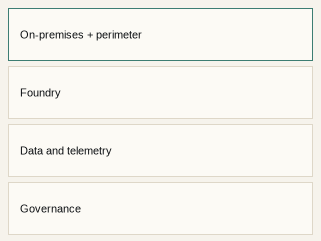
Text version of this figure
- Corporate clients and on-premises resolvers reach the service through a private endpoint subnet; public network access is disabled.
- Private DNS zones, linked to the hub and forwarded from on-premises, resolve the AI service names to private addresses.
- Azure AI Foundry, Key Vault, storage and search, and Log Analytics are reachable only through that perimeter.
- A managed identity with scoped role assignments calls the service; no model key sits in application configuration.
- An egress allow-list and a declared retention period bound what leaves the workload and what is kept.
03 · How the work runs
- Draw the perimeter firstDecide where the private endpoint subnet lives, which hub connects it, and which route is the only way in. Confirm that public network access on the AI resource is disabled, and check each feature the team needs against that setting rather than assuming parity.
- Own the namesCreate the private DNS zones before the endpoints, link them to the hub, and give each zone an owner and a record-change path. Add conditional forwarders for on-premises clients and test resolution from each network segment that will call the service.
- Remove keys from the pathUse a managed identity for the workload and scoped role assignments for people who deploy models. Keys remain a break-glass option with custody recorded, not the default that ends up in a pipeline variable.
- Decide what leaves and what staysSet diagnostic settings to a central workspace, decide prompt and response retention, and record the data classification of everything used for grounding. Where customer-managed keys are required, agree who holds custody before the first deployment.
- Test the boundary as a deploymentRun representative calls from each network: hub, spoke, on-premises, and CI. Verify that a public call fails, that private calls resolve, and that logs show the caller. A boundary nobody tested is a diagram.
04 · The controls
- No public network access to model endpoints; the only path is the private endpoint subnet.
- Every private DNS zone has an owner, a link scope, and a reviewed change path, including on-premises forwarding.
- Workloads call the service with a managed identity; human deployment rights are role-scoped and reviewed.
- Prompts, responses, and grounding data have a declared retention period and a workspace that only named roles can read.
- Egress from the workload subnet is allow-listed; a model call cannot quietly leave through a different route.
05 · Trade-offs
| Decision | What you gain | What you give up |
|---|---|---|
| Private endpoints for every AI resource | The model endpoint has no public front door. | A monthly cost and a per-resource operational load, plus a naming and ownership convention the estate has to keep or it becomes unmaintainable. |
| Verify each capability in the target region | A feature gap is found before a workload depends on it. | Feature availability under private networking can differ by service and region, so each capability has to be verified in the target region rather than assumed. |
| Give DNS a change process and named owners | Resolution is verified per segment, and a zone change follows a reviewed path. | A fast incident fix may need an approval that is not available at 02:00, so the forwarder and zone ownership have to be designed for that hour. |
| Treat private connectivity as one control | The path is protected and testable. | It does not classify the data, decide retention, or replace an access review; those still need an owner and a separate decision. |
06 · What changes
- A call from the public internet to the model endpoint fails, and the failure is expected rather than surprising.
- Resolution from hub, spoke, on-premises, and CI returns the private address, verified per segment.
- No application configuration contains a model key; the deployed identity is a managed identity.
- Diagnostic logs answer who called, from where, and when, without asking the application team.
07 · Out of scope
- Not a data-classification or records-retention programme; those decisions stay with the client's owners.
- Model and vendor selection depends on residency, procurement, and the feature set that survives private networking.
- No claim of certification, audit opinion, or regulatory approval.
- Existing public endpoints are inventoried and migrated deliberately, not switched off in one change.
Related
The offer and the writing behind it.
Cloud governance
The offer this scenario sits inside. Scope, boundaries and the questions worth answering first.
See the offer
Cloud governance engineers can actually use
Azure governance is not a policy library. It is the experience an engineer has when a control helps, blocks, or surprises them.
08 Oct 2026 · 5 min readAnother use case
A multi-agent workflow that cannot act without a signature